Assisted Living vs In-Home Care Costs in Venice, FL
Local cost medians and real caregiver schedules can help Venice families compare assisted living with remaining at home.
For families weighing assisted living vs in-home care cost in Venice, FL, the hourly rate is only the beginning. A useful comparison looks at how many hours of help are needed, who covers the rest of the day and which household expenses continue at home. It also treats an assisted living median as a regional benchmark, not a price quote for any one residence.
That regional view gives spouses and adult children a starting budget before they gather provider-specific rates, care assessments and benefit information.
Assisted living vs in-home care cost in Venice, FL: the local baseline
The following figures from show why the schedule matters as much as the hourly rate.
That highest schedule illustrates the cost of continuous paid coverage; it is not a prediction of what every household needs.
A lower care bill is not necessarily a lower total budget
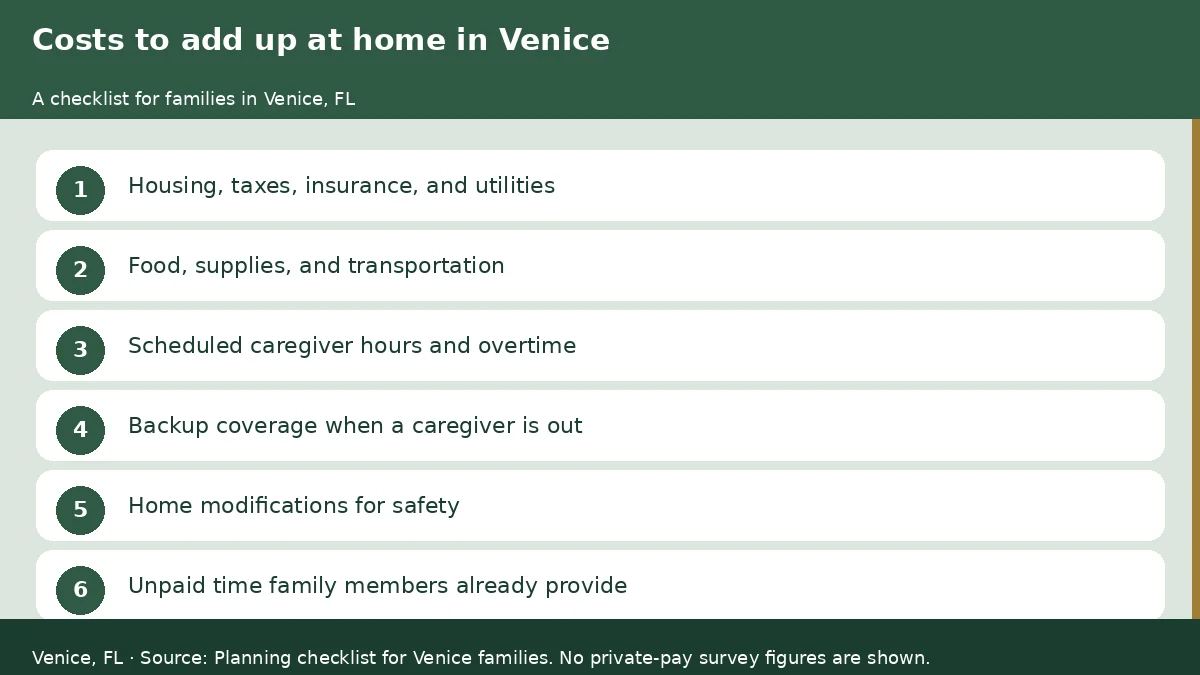
A lower invoice does not automatically mean a lower total budget. Someone receiving part-time help may still need meal preparation, transportation, supervision or quick assistance between visits. Families should map who handles mornings, evenings, weekends and nights rather than assuming that a caregiver's scheduled hours cover every need.
Staying at home also keeps the household budget in place. Utilities, groceries, home maintenance, property-related expenses and transportation continue. Some homes may need better lighting, grab bars, a ramp or bathroom changes, and the appropriate modifications depend on the person and the property. Caregivers may not provide home repairs, yard work or every household errand, so those responsibilities need their own plan.
Family time belongs in the comparison even when no invoice is attached. Coordinating visits, cooking, driving, handling laundry and remaining available can affect sleep, work and other relationships. A simple log of tasks and hours for a typical week is more useful than assigning an arbitrary dollar value to that effort.
How the Venice-area benchmark compares
These comparisons provide context, not a verdict on value. A family in Venice still needs to know what a particular residence includes, how care needs are assessed and which charges can change. Annual figures can support planning, but they do not guarantee what any household will pay.
Read an assisted living quote line by line
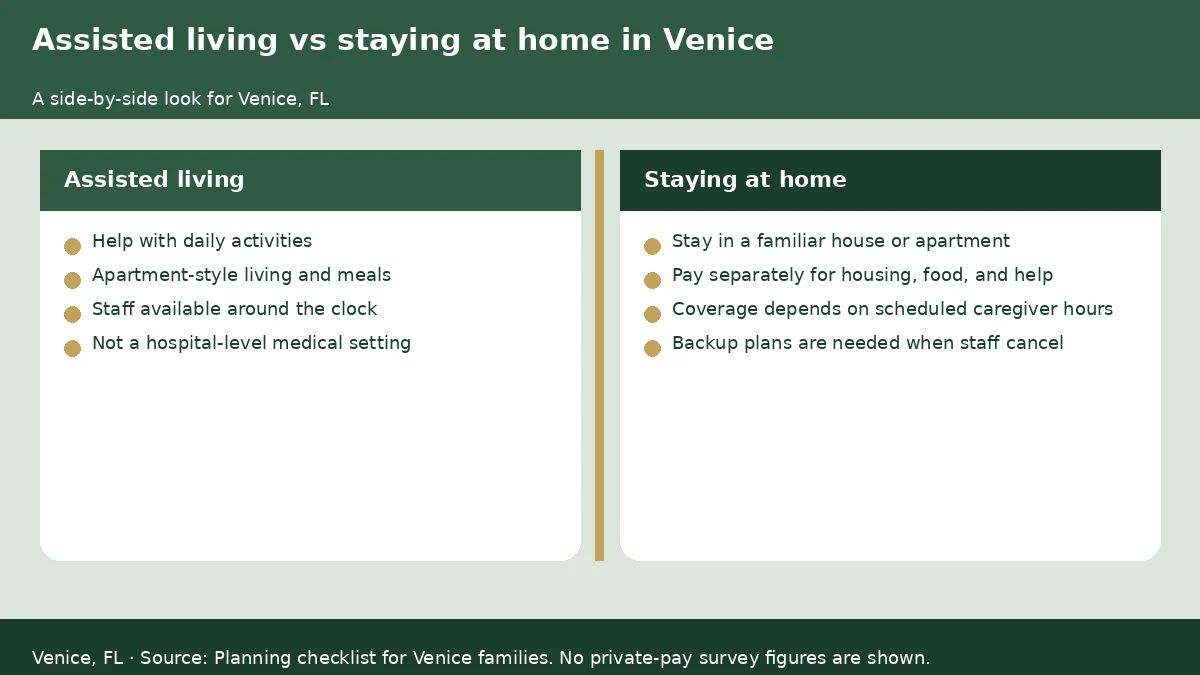
Assisted living deserves the same line-by-line review as a home care proposal. Ask what the monthly rate covers and what is billed separately. Meals, housekeeping, laundry, transportation, personal care and medication reminders may be handled differently by different providers. Also ask how an assessment affects the service plan, when rates can change and whether there are fees for moving in or changing the level of support.
Magnolia Gardens Assisted Living is at 350 Magnolia Rd in Venice and offers assisted living, memory care and respite stays. Families can read about assisted living in Venice and then call the home for current rates and a precise list of included services. The regional median is not Magnolia Gardens' price.
If dementia is part of the decision, compare supervision, daily support and the living environment in each setting. Memory care should not be described as a cure or as a promise to change the course of a condition. The practical question is whether support and supervision match the person's needs and whether the family understands how those needs will be reviewed.
Build a like-for-like comparison before choosing
A like-for-like worksheet keeps the discussion grounded. Use the same typical week for both options and write down assumptions that would change the result.
- Map the help needed. List personal care, meals, mobility support, supervision, transportation and nighttime needs. Mark which tasks require paid help and which family members can realistically cover.
- Request a written home care schedule. Ask about visit minimums, weekend or holiday coverage, cancellations, backup caregivers and whether household tasks are included. Confirm the total weekly hours rather than relying on a single hourly rate.
- Request a written residential service list. Compare the monthly rate, included support, possible additional charges and the process for reassessment. Ask for current rates directly from each provider.
- Add the costs and responsibilities of home. Include food, utilities, upkeep, transportation and any modifications being considered. Keep family coordination time visible even if you do not turn it into a dollar amount.
- Test the travel routine. For relatives coming from South Venice, Nokomis, Englewood, North Port or Sarasota, consider whether US-41 (Tamiami Trail) or Interstate 75 makes regular visits manageable. A workable visiting plan can matter alongside the budget.
Respite and adult day support can add information
Not every decision has to move directly from full-time home care to a permanent residential change. The National Institute on Aging explains that respite care gives family caregivers a short-term break and can occur at home, in an adult day center or through a short stay in a residential facility. A short stay can provide practical information about routines and fit without predicting the future.
Magnolia Gardens offers respite stays in Venice; families can review respite stays and ask about availability, current rates and planning. Ask what days and hours that figure represents and whether transportation or other needs would remain at home. Neither benchmark substitutes for around-the-clock supervision when that level of oversight is needed.
Check coverage and benefits without assuming they apply
Coverage rules should be checked before they are built into a budget. Medicare states that it does not cover long-term custodial care if that is the only care needed, and most long-term care is custodial. That point applies to ongoing daily support rather than to a promise that either setting will be paid for.
Long-term care insurance is different. According to the Administration for Community Living, some policies can pay for assisted living, depending on their terms. Benefits commonly depend on an elimination period and on needs involving activities of daily living or cognitive impairment. Read the policy for benefit limits, covered settings, provider requirements and claim procedures.
Eligible wartime-era Veterans and surviving spouses may also want to review VA pension benefits. The VA's Aid and Attendance guidance describes an increased pension amount for people who need help with daily activities or meet other listed circumstances. Current VA pension rates list a maximum annual pension rate with Aid and Attendance of $29,093 for a Veteran with no dependents and $34,488 for a Veteran with one dependent. The net worth limit from December 1, 2025 through November 30, 2026 is $163,699. Actual eligibility and payments depend on VA's rules, including countable income and review of certain asset transfers.
Florida's Statewide Medicaid Managed Care Long-Term Care program can cover services including assisted living services, personal care, adult day care and respite for Medicaid-eligible people who meet the program's age or disability and nursing-facility-level-of-care requirements. Enrollment is limited and there is a waitlist. Screening begins through the local Aging and Disability Resource Center, so early contact can clarify the process without implying that help is guaranteed.
Use the numbers to support a careful decision
Before choosing a residence, families can also consult the Florida Agency for Health Care Administration's assisted living guidance. AHCA licenses assisted living facilities and recognizes specialty licenses for particular services. Florida also requires Alzheimer's and dementia training for staff in facilities that advertise memory care. Ask a provider which license it holds, what services it can provide and what happens if needs change.
A sound assisted living vs in-home care cost decision in Venice combines regional benchmarks with a real weekly schedule and written provider information. The aim is not to make one setting look universally less expensive. It is to see who provides each needed hour of support, which expenses remain and whether the plan is sustainable for the older adult and the family.
Frequently asked questions
Is assisted living cheaper than in-home care in Venice, FL?
Neither comparison includes every household expense, assisted living service or family caregiving hour. Venice families should compare written quotes for the same needs.
Why are Venice costs listed under the North Port Area?
For this comparison, that provides the local benchmark within the North Port-Sarasota-Bradenton metro area used for Sarasota County. It is a regional median, not a quote for Magnolia Gardens or any other provider. The home's actual rate can depend on its current pricing and the services included, so families should call Magnolia Gardens directly for current rates and request a written service list.
Does Medicare pay for assisted living or ongoing custodial care at home?
Medicare does not cover long-term custodial care when that is the only care needed, and most long-term care is custodial. That limitation matters whether support is needed at home in Venice or in an assisted living setting. Families should not assume that Medicare will pay an ongoing assisted living bill or indefinite caregiver schedule. Ask Medicare, the care provider and any insurance carrier how a specific situation is handled, and request answers in writing.
Can a respite stay help a Venice family compare care options?
A respite stay can give a family caregiver a short-term break and may be arranged in a residential setting. It can also help a Venice family observe daily routines, ask practical questions and consider whether the environment feels manageable, without treating a short stay as a guarantee about the future. Magnolia Gardens Assisted Living offers respite stays as well as assisted living and memory care. Ask about availability, current rates, included services and how the stay would be planned.
What benefits might help pay for long-term care in Venice?
Start with Florida's Statewide Medicaid Managed Care Long-Term Care program, long-term care insurance and, for eligible wartime-era Veterans or surviving spouses, VA pension benefits with Aid and Attendance. Each has its own eligibility rules, and the state program has limited enrollment and a waitlist. Screening for the state program begins through the local Aging and Disability Resource Center. Venice families should also review policy elimination periods and ask VA how countable income and unreimbursed medical expenses affect a claim.
Talk with Magnolia Gardens Assisted Living
If you are weighing care options in Venice, call (941) 412-4092 or plan a visit. Our team can talk through current availability, rates and next steps. Please confirm all details directly, since published figures and listings change over time.
Sources
- VA Aid and Attendance and Housebound benefits
- VA pension rates (current)
- Medicare: long-term care coverage
- National Institute on Aging: What is respite care?
- ACL: What is long-term care insurance
- Florida AHCA: Assisted Living Unit
- Florida AHCA: Statewide Medicaid Managed Care Long-Term Care Program
Program rules and benefit amounts were checked on the linked official pages in November 2026 and can change.