Assisted Living vs Memory Care Costs in Venice
A practical comparison of support, daily life and local costs to help Venice families choose the right care conversation.
For many Venice families, the cost conversation begins after a spouse stops managing meals, a parent misses steps in a familiar routine, or caregiving starts to crowd out sleep. Researching assisted living vs memory care cost in Venice, FL, can be confusing because the two options are built around different kinds of support. Magnolia Gardens Assisted Living, at 350 Magnolia Rd in Venice, offers assisted living, memory care and respite stays. This guide compares daily life, supervision, local cost benchmarks and payment questions without treating either setting as a medical solution or using an assisted living rate as a memory care quote.
Start with the support your parent needs
Assisted living generally fits an adult who wants to remain socially engaged and make everyday choices, but needs reliable help with selected tasks such as bathing, dressing, meals or medication routines. The central question is not whether the person can do everything independently. It is whether the available support matches the tasks that have become difficult while leaving room for preferences and remaining abilities.
Memory care is intended for someone whose cognitive changes call for more consistent cueing, supervision and structure. Daily life may be organized around familiar routines, simpler choices and an environment planned for dementia-related support. A diagnosis alone does not settle the decision. Two people with the same diagnosis can have very different needs, so current function, nighttime patterns and the amount of standby help required deserve more weight than a label.
Compare daily life, staffing and environment
| Feature | Assisted living | Memory care |
|---|---|---|
| Who it may fit | Someone needing help with selected daily tasks while retaining some self-direction | Someone needing cognitive support, consistent cueing and closer supervision |
| Daily routine | Individual preferences combined with scheduled services and activities | More structured and predictable routines, with choices presented accessibly |
| Environment | Ask about layout, accessibility and how assistance reaches the resident | Ask about dementia-specific design, supervised access and quiet spaces |
| Staff conversation | Ask who assesses needs and how the service plan is updated | Ask about dementia training, supervision and responses to changing needs |
| Family observation | Can your parent follow the routine and obtain help when needed? | Does the routine match your parent's current abilities and support needs? |
A visit to assisted living in Venice should include a description of an ordinary day, not just a look at the residence. Ask which tasks staff regularly support, how residents request help and what happens when needs increase. For memory care, use the same approach while focusing on cueing, supervision and environmental support. The table is a discussion guide, not a promise that every community uses the same model.
Assisted living vs memory care cost in Venice, FL
The uses the North Port Area for Venice, providing the local benchmark for this discussion of the North Port-Sarasota-Bradenton metro. These are market reference points, not rates for any one community.
A sound assisted living vs memory care cost comparison in Venice begins with written quotes based on the same person's current needs.
Ask each community to explain which housing, personal care and supervision services its quote covers. For current rates at Magnolia Gardens, including what is included with assisted living, memory care or a respite stay, families should call the community directly. A quote becomes more useful when it also explains how the service plan is reviewed and how families are notified of changes.
Why the care setting changes the quote
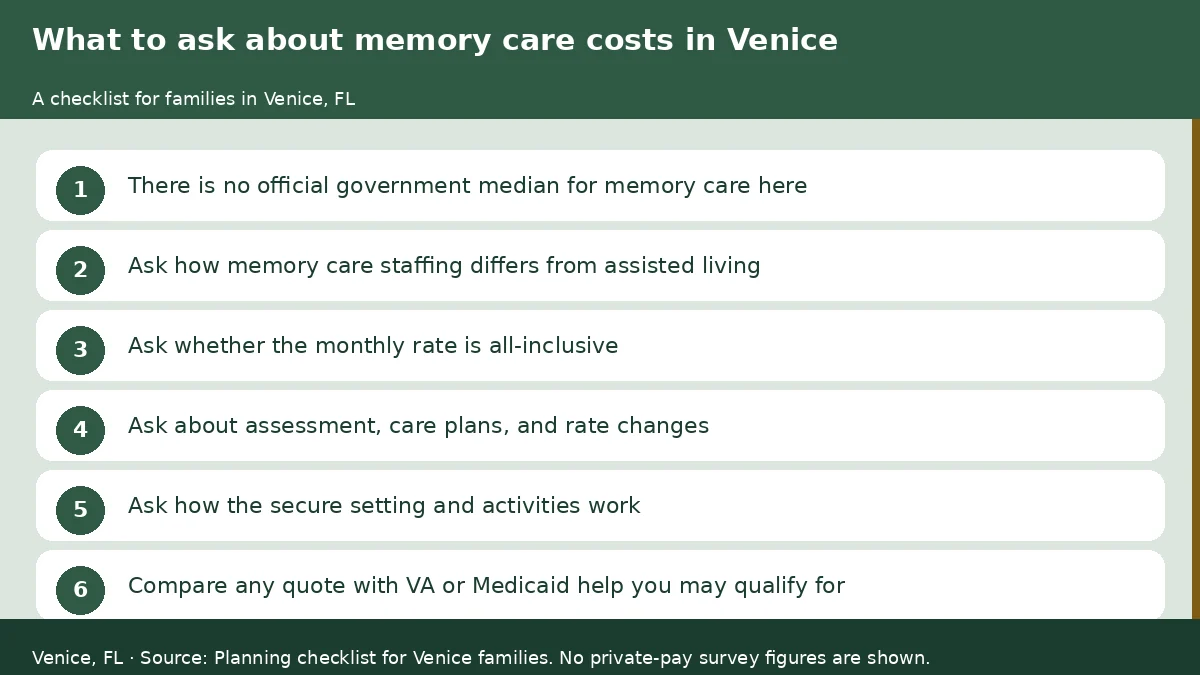
Memory care pricing cannot be responsibly inferred by adding an assumed percentage to an assisted living median. The setting may involve different staffing patterns, supervision, activity design and environmental features, but those details vary. Ask what is actually provided rather than relying on the category name.
Request a written explanation of which activities of daily living are supported, how cognitive support needs are assessed and whether care levels affect charges. Ask which services or supplies could be separate, what notice accompanies a change and whether another setting could become necessary later. Clear answers make two quotes easier to compare and reduce the risk of comparing a broad service package with a much narrower one.
Put home care, day care and nursing care in context
also help frame alternatives.
It may enter the discussion when a spouse or adult child needs scheduled daytime support, but it is not interchangeable with residential care or unrestricted home supervision.
Nursing home costs reflect a different level and setting of care. They should not be used as stand-ins for memory care pricing.
These comparisons are not perfectly like-for-like. Home care can leave household, meal and maintenance expenses in place; adult day care covers a particular schedule; nursing care serves different needs. List what each option includes, including family caregiver time, before comparing the totals.
Review payment sources without assuming eligibility
Medicare's long-term care guidance says Medicare does not cover long-term custodial care when that is the only care needed, and most long-term care is custodial. Families should not assume that assisted living room, board or ongoing daily support will be paid by Medicare.
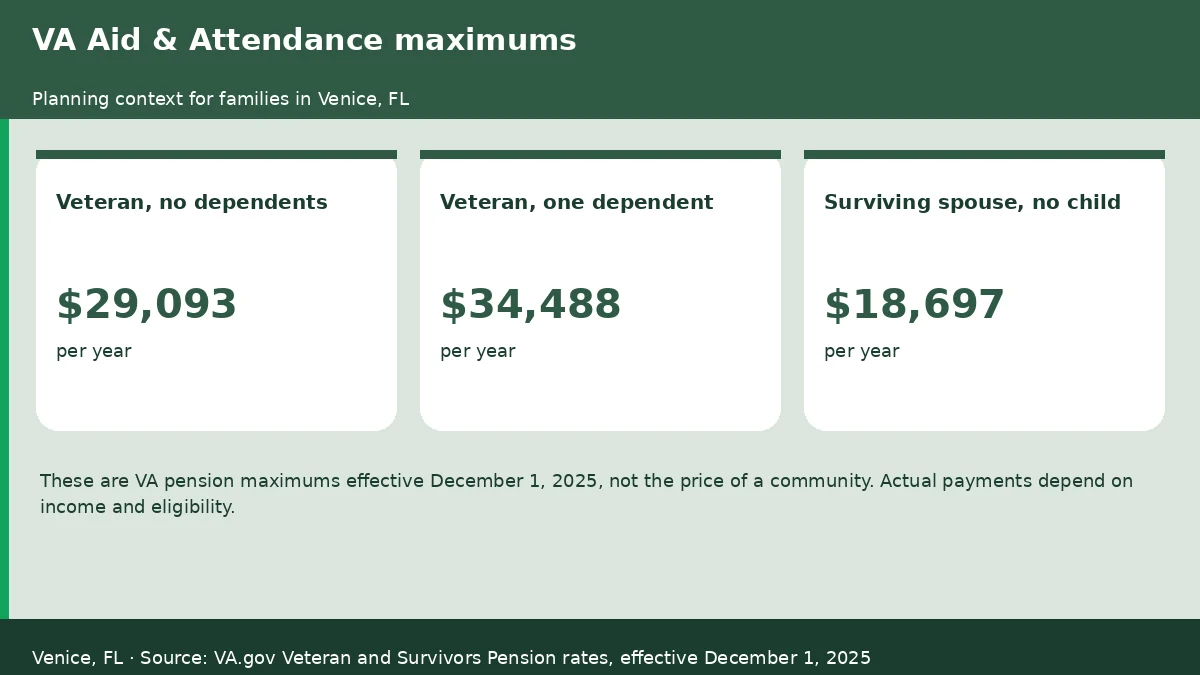
VA Aid and Attendance can increase a pension for eligible wartime-era Veterans or surviving spouses who need help with daily activities or meet other criteria. The VA pension rate guidance explains that countable income affects the pension and that certain unreimbursed care expenses can matter. Asset-transfer rules also apply. Eligibility is individual, so a diagnosis or residence alone does not establish a benefit.
Long-term care insurance may pay for assisted living services, depending on the policy. Benefits commonly depend on an elimination period and specified needs involving daily activities or cognitive impairment. Read the actual policy and ask the insurer how its definitions, documentation requirements and limits apply.
Florida's Statewide Medicaid Managed Care Long-Term Care program can cover services including assisted living services, personal care, adult day care and respite for people who meet eligibility and level-of-care requirements. Enrollment is limited and there is a waitlist; screening begins through the local Aging and Disability Resource Center. The Eldercare Locator can also connect families with local aging-resource offices.
How to tell which option fits now
Look at the present week rather than relying only on a diagnosis or a single difficult day. Specific observations make an assessment more useful:
- Which tasks remain unfinished or unsafe even after reminders?
- Does your parent need cueing through most steps, or help with only certain tasks?
- Are nights, meals, medication routines or unsupervised exits creating concerns?
- Can the family sustain its current caregiving schedule without neglecting health, work or other responsibilities?
Assisted living may fit when defined support fills the gaps and your parent can still use much of the routine independently. A memory care conversation becomes more relevant when cognitive changes call for continuous structure, repeated cueing or closer supervision. At Magnolia Gardens, which offers both types of care, ask staff to explain how they distinguish those needs.
A respite stay can also give a family caregiver a short-term break. The National Institute on Aging notes that respite can occur at home, in an adult day center or during a short residential stay. It can support the family's planning process, but it does not replace a careful assessment or guarantee that one setting will remain appropriate.
Prepare for a useful Venice-area visit
Florida's Agency for Health Care Administration licenses assisted living facilities and describes specialty license types. Its assisted living regulatory overview also notes dementia-training requirements for staff in facilities that advertise memory care. Use that background to ask which license, training and services apply to the specific care being discussed.
- Request a written service description and a sample explanation of how care needs are reviewed.
- Ask who families contact about changes in routines, supervision or charges.
- Observe whether residents can obtain assistance and whether the environment is understandable to your parent.
- Discuss respite separately, including available services, stay arrangements and current rates.
- Consider the practical drive for visitors from South Venice, Nokomis, Englewood, North Port or Sarasota, including routes using US-41 and Interstate 75.
The strongest comparison combines observed support needs, written service details and current quotes. Neither a local median nor a diagnosis makes the decision by itself; the goal is a setting whose supervision, environment and daily routine match the person as they are now.
Frequently asked questions
What is the main difference between assisted living and memory care in Venice?
Assisted living generally supports people who need help with some daily tasks but can use a less structured routine. Memory care is designed around cognitive support, consistent cueing, supervision and an environment planned for dementia-related needs. The decision depends on current function and safety needs, not a diagnosis alone. Magnolia Gardens in Venice offers both types of care, along with respite stays, so families can ask how staff determine which option fits.
Why there is no official memory care median for Venice
It should not be treated as a memory care quote or a rate for Magnolia Gardens. Ask the community for current memory care pricing, what supervision and services are included, how care plans are reviewed and whether any separate charges apply.
How do home care and assisted living costs compare near Venice?
That comparison does not include every household expense or establish what either option would cost your family. Care needs, schedules and written service inclusions still matter.
Does Medicare pay for assisted living or memory care in Venice?
Medicare generally does not cover long-term custodial care when that is the only care needed, and most long-term care is custodial. That applies whether help is delivered in assisted living or a memory care setting. Families can instead review long-term care insurance policy language, possible VA pension benefits and Florida Medicaid long-term care eligibility. Each potential source has its own rules, limits and application process.
Can a respite stay help our family decide between care options?
Respite care gives a family caregiver a short-term break and can take place at home, in an adult day center or during a short residential stay. Magnolia Gardens offers respite stays in Venice. A stay may help a family understand routines and discuss support needs, but it does not replace a careful assessment or guarantee that one setting will remain appropriate. Ask in advance about stay arrangements, included services and current rates.
Talk with Magnolia Gardens Assisted Living
If you are weighing care options in Venice, call (941) 412-4092 or plan a visit. Our team can talk through current availability, rates and next steps. Please confirm all details directly, since published figures and listings change over time.
Sources
- VA Aid and Attendance and Housebound benefits
- VA pension rates (current)
- Medicare: long-term care coverage
- Eldercare Locator (U.S. Administration for Community Living)
- National Institute on Aging: What is respite care?
- ACL: What is long-term care insurance
- Florida AHCA: Assisted Living Unit
- Florida AHCA: Statewide Medicaid Managed Care Long-Term Care Program
Program rules and benefit amounts were checked on the linked official pages in November 2026 and can change.