Signs It's Time for Assisted Living: A Guide for Venice Families
A practical guide to changes at home, caregiver strain, dignified conversations, respite stays and care costs for families in Venice and nearby Sarasota County communities.
Families rarely decide on assisted living because of one difficult afternoon. More often, a spouse or adult child notices a pattern: meals skipped, laundry piling up, a near fall, growing confusion about medicines, or days with little company. If you are searching for the signs it's time for assisted living, Venice families can begin by looking at daily life with patience rather than alarm. The goal is not to take over a parent's decisions. It is to understand what has become hard, what still feels manageable, and what support would preserve choice and dignity.
In Venice, South Venice, Nokomis and nearby Sarasota County communities, the same question can look different from one household to the next. A person may need little physical help but be lonely and no longer driving. Another may remain socially engaged while a spouse becomes exhausted by daily care. Look at the whole routine, including who provides unpaid help and whether that arrangement remains safe and sustainable.
Physical changes and a household that is harder to maintain
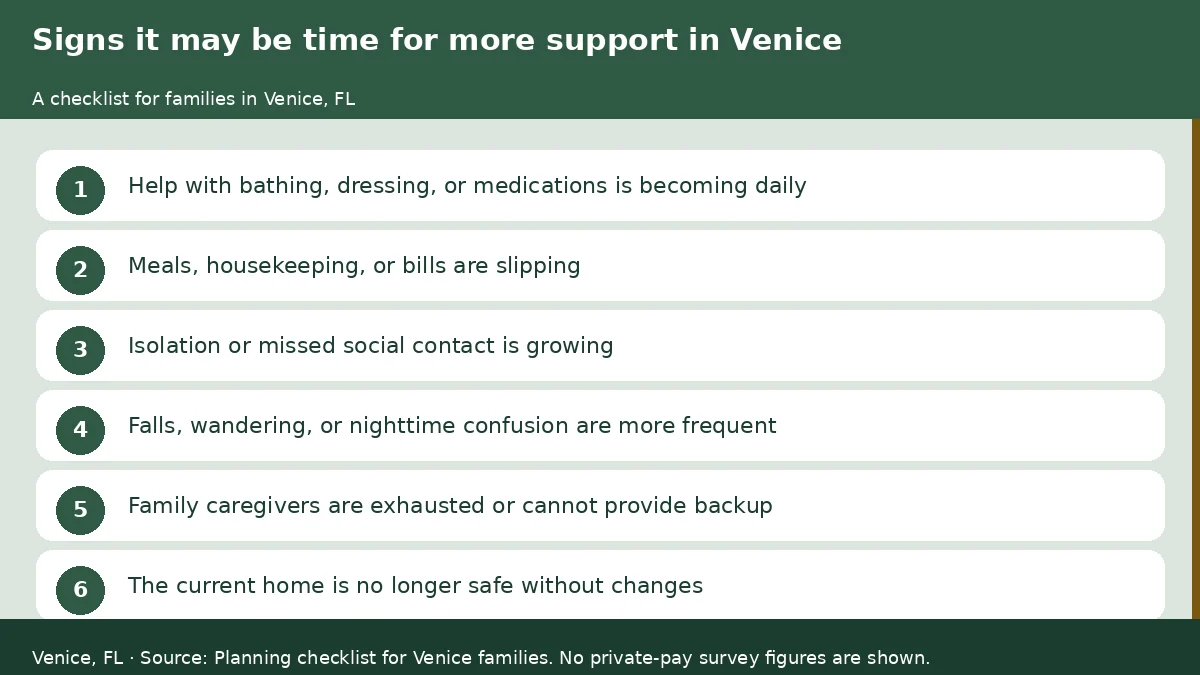
Physical change is often easiest to see in ordinary tasks. A parent who once enjoyed cooking may rely on snacks, leave food uneaten or avoid using the stove. Laundry, cleaning, yard work and home repairs may gradually go undone. Also notice changes in bathing, dressing, walking, getting out of a chair or managing stairs. These observations are not a diagnosis. They show where a routine may no longer match a person's abilities.
- Food spoils, cupboards stay empty, or regular meals are replaced by snacks.
- Clothing, bedding or the home is noticeably less clean than before.
- Personal grooming becomes infrequent, or getting dressed takes substantial help.
- Furniture is used for balance, or routine movement around the home causes near falls.
Ask which tasks your parent avoids and why. Pain, poor eyesight, grief, limited transportation and other issues can produce similar signs. The useful question is not whether the house meets someone else's standard, but whether daily needs are consistently being met without unsafe effort.
Safety, medication and memory concerns
Safety concerns deserve particular attention when they repeat. Examples include leaving a burner on, becoming disoriented outside the home, falling, or being unable to summon help. A single event may have a simple explanation, but several events can reveal that supervision or a different living arrangement deserves discussion. Sudden confusion, a new fall or a major change in function warrants prompt professional evaluation rather than an assumption that assisted living alone is the answer.
Medication concerns also call for specifics. Look for unfilled prescriptions, duplicate doses, pills left in an organizer or uncertainty about why a medicine is taken. Avoid diagnosing dementia from one forgotten appointment. Instead, record what happened and ask a pharmacist or clinician to review the medication routine. When touring communities, ask exactly who handles medication storage, ordering, reminders and documentation, and how the process changes if a resident needs more assistance.
Social isolation and caregiver strain matter too
A person can have a tidy house and still need a different kind of support. Withdrawal from longtime friends, abandoned hobbies, few conversations during the week or reluctance to leave home may signal loneliness or difficulty getting out. Do not assume that moving automatically creates companionship. Ask how any setting supports individual preferences, accessible activities and continued contact with family, faith communities and friends.
Caregiver strain is equally relevant. A spouse who is injured while helping, missing sleep or neglecting personal appointments may not be able to continue safely. Adult children may be providing increasing care while managing work and their own households. Exhaustion and resentment do not mean a family cares less. They can indicate that the current plan depends on more time, physical effort or availability than the family can reliably provide.
Signs It's Time for Assisted Living Venice Families Can Discuss
A respectful conversation begins before a crisis whenever possible. Your parent should be included as a participant, not presented with a decision made elsewhere. Acknowledge the parts of home life that remain important, and be honest about your own limits without using blame.
- Choose a calm time, allow enough privacy and avoid starting immediately after an argument.
- Describe specific observations, such as missed meals or a near fall, rather than applying a label.
- Ask what your parent wants to protect, including privacy, routines, pets, friendships and control over decisions.
- Offer practical choices for exploration, such as additional home help, an assessment, a community visit or a short stay.
Expect several conversations. A spouse or parent may agree that cooking is difficult while rejecting the idea of moving. That partial agreement can still lead to a useful next step. If capacity to make decisions is uncertain, seek appropriate professional guidance rather than trying to settle the question through pressure.
How assisted living, memory care and respite differ
Assisted living generally combines housing with personal support and help with daily routines. Memory care is intended for people who benefit from dementia-related support, supervision and an environment designed around their needs. It should not be described as a cure or a promise of improvement. The right setting depends on current abilities, safety needs, preferences and the services actually available.
Magnolia Gardens Assisted Living, at 350 Magnolia Rd in Venice, offers assisted living, memory care and respite stays. Families comparing assisted living in Venice with help at home can ask what daily assistance, meals, medication support and additional care would involve. Short-term respite stays may also give everyone a concrete experience to discuss. The National Institute on Aging explains that respite care gives family caregivers a short-term break and can occur at home, in adult day centers or in residential settings.
Before a respite stay, agree on its purpose, length and what everyone will review afterward. Florida's Agency for Health Care Administration licenses assisted living facilities, and its assisted living licensing guidance also describes specialty licenses and dementia-training requirements for facilities advertising memory care. Ask to see licensing information and request clear answers about supervision, staff training, family communication and what happens if needs exceed the available services.
What Venice-area cost figures mean for planning
The , based on data collected from July through November 2025, places Venice in its North Port Area region. This is part of the North Port-Sarasota-Bradenton metro used for local planning. The figures below are survey reference points, not quotes for any individual community.
These categories purchase different kinds of support, so compare caregiver hours, housing, meals and other included services rather than looking at monthly totals alone.
None of these figures is a rate for Magnolia Gardens. Families should call the community for current rates and request a written explanation of included services, possible additional charges and how changes in care needs affect billing. A community quote and a regional median answer different questions, and both can be useful when building a realistic plan.
Payment sources require careful verification
Families should not assume that health insurance will cover an ongoing residential stay. Medicare's long-term care guidance states that Medicare does not cover long-term custodial care when that is the only care needed, and most long-term care is custodial. Ask specifically what, if anything, a separate insurance arrangement covers.
Long-term care insurance can pay for assisted living, depending on the policy. Benefits commonly depend on an elimination period and requirements involving activities of daily living or cognitive impairment. Read the actual policy, confirm the benefit triggers and ask how claims are documented.
VA Aid and Attendance can increase a VA pension for qualifying wartime-era Veterans or surviving spouses who need help with daily activities or meet other criteria. It is not a flat care reimbursement. The VA's current pension rate information explains countable income, unreimbursed medical expenses, net worth and asset-transfer rules. Florida's Statewide Medicaid Managed Care Long-Term Care program may cover assisted living services and other supports for eligible people who need nursing facility level of care, but enrollment is limited and a waitlist applies. The Eldercare Locator can also connect families with local aging-service organizations.
Turn observations into a measured plan
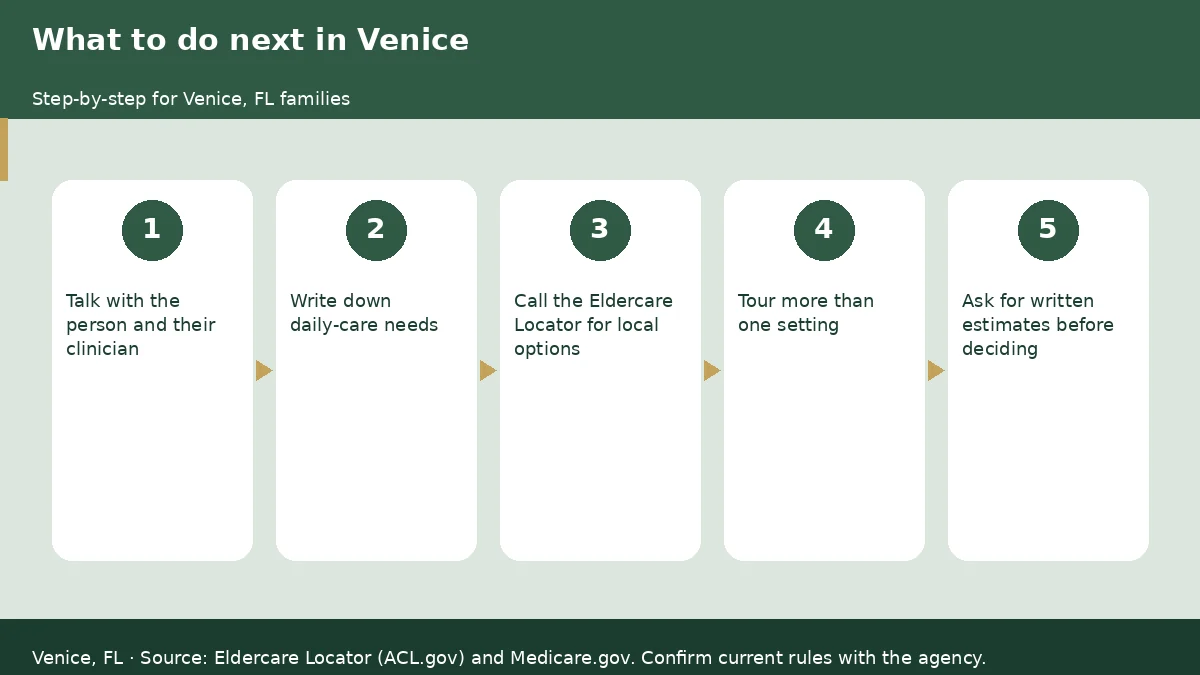
Keep brief notes about daily difficulties, bring medication and care questions to professional appointments, and compare more than one way of providing support. For relatives traveling from Nokomis, Englewood, North Port or Sarasota, consider whether routes using US-41 or Interstate 75 make regular visits realistic. During a visit, observe routines and ask for clear answers rather than relying on appearance alone.
For Venice families, the signs it's time for assisted living are most useful when they lead to a shared plan. That plan might begin with help at home, a respite stay or a community assessment rather than an immediate move. The purpose is not to win an argument. It is to build support that is safe, understandable and acceptable to the person who will live with it.
Frequently asked questions
What are the clearest signs a Venice parent may need assisted living?
Look for repeated difficulty with bathing, dressing, meals, mobility, household upkeep or medication routines, especially when safety or isolation is also changing. A single mistake does not settle the question. Write down specific events, ask your parent how daily tasks feel, and involve a clinician when a new symptom or sudden confusion appears. The decision should balance current abilities, the support available at home and your parent's own preferences.
Can a respite stay in Venice help with the decision?
A short respite stay can give a family caregiver a break and let everyone see how an older adult manages a residential routine before making a longer commitment. Magnolia Gardens offers respite stays as well as assisted living and memory care. Agree on the purpose of the stay, what information to share and what you will review afterward. A stay should be treated as an experience to discuss, not proof that a move is required.
How much does assisted living cost near Venice, Florida?
These are planning benchmarks, not a quote for Magnolia Gardens or any other community. Ask each community for current rates, included services, possible additional charges and how costs may change if care needs increase.
Does Medicare cover assisted living in Venice, Florida?
Medicare does not cover long-term custodial care when that is the only care needed, and most long-term care is custodial. Families therefore should not assume Medicare will pay for an ongoing assisted living stay. Other possibilities include long-term care insurance, VA benefits for eligible people and Florida's Medicaid long-term care program for those who meet financial and care requirements. Review each policy or program directly, because eligibility, waiting periods and covered services vary.
What should families ask about memory care in Venice?
Ask how the community provides supervision, daily support and a suitable environment, and how it responds when a person's needs change. Florida requires Alzheimer's and dementia training for staff in facilities that advertise memory care, so ask how that training is provided and maintained. Also request licensing information, medication procedures, family communication practices and respite options. Memory care should not be presented as a cure or a promise of improvement; it is a form of support and supervision.
Talk with Magnolia Gardens Assisted Living
If you are weighing care options in Venice, call (941) 412-4092 or plan a visit. Our team can talk through current availability, rates and next steps. Please confirm all details directly, since published figures and listings change over time.
Sources
- VA Aid and Attendance and Housebound benefits
- VA pension rates (current)
- Medicare: long-term care coverage
- Eldercare Locator (U.S. Administration for Community Living)
- National Institute on Aging: What is respite care?
- ACL: What is long-term care insurance
- Florida AHCA: Assisted Living Unit
- Florida AHCA: Statewide Medicaid Managed Care Long-Term Care Program
Program rules and benefit amounts were checked on the linked official pages in November 2026 and can change.
Related reading on this site: