Florida Assisted Living Licensing and Regulations Explained
A plain-English guide to Florida licensing, memory care rules, oversight, and practical questions for families comparing assisted living in Venice.
Florida assisted living regulations are easier to use when they are treated as a set of practical questions rather than a stack of legal citations. Who licenses the residence? Which license does it hold? What training is required when memory care is advertised? Where can a family ask about oversight? For adult children and spouses comparing options in Venice, those questions belong beside conversations about daily help, supervision, surroundings and cost. A license is an important starting point, but it is not a promise that a particular community will fit a particular person.
Magnolia Gardens Assisted Living is at 350 Magnolia Rd in Venice, in Sarasota County on Florida's Gulf Coast, and offers assisted living, memory care and respite stays. The framework below applies across Florida. It can help a family prepare for a tour, read an agreement more carefully and separate regional cost benchmarks from a community's own current rates.
Who licenses assisted living in Florida?
The Florida Agency for Health Care Administration, known as AHCA, licenses assisted living facilities under Part I of Chapter 429, Florida Statutes. The associated rules are in Chapter 59A-36, Florida Administrative Code. Those citations matter because they give families a precise reference when a conversation becomes vague. Instead of accepting a general statement that a residence is state regulated, ask for its license information and the exact name of any specialty license.
Within Florida assisted living regulations, AHCA also identifies three specialty license names: Extended Congregate Care, Limited Nursing Services and Limited Mental Health, often abbreviated ECC, LNS and LMH. Do not infer a service package from an abbreviation alone. Ask what the residence's license means for the support being discussed. Adult Family-Care Homes are different again. They fall under Part II of Chapter 429 and are private homes where the licensee lives and cares for up to five residents. They are a separate, smaller license type, not simply another name for an assisted living facility under Part I.
What Florida assisted living regulations mean for memory care
Florida requires Alzheimer's disease and dementia training for staff in facilities that advertise memory care, under section 429.178 of the Florida Statutes. That requirement gives families a specific training question to ask, but it does not describe every detail of a community's program. When comparing assisted living in Venice with memory care, ask who receives training, how the setting provides supervision and how the environment is intended to support daily routines.
Keep the language grounded. Memory care can provide support, supervision and a structured environment; it should not be presented as a cure or a promise of improvement. A license label also does not answer whether a person prefers a quieter room, needs help at particular times of day or will feel comfortable with the routine. Those are individual fit questions. The the National Institute on Aging's respite care guidance is also useful for caregivers considering temporary help, and its 24/7 Helpline is 1-800-272-3900.
How to approach inspections and complaints
Licensing, inspection information and complaint handling are related, but they are not interchangeable. AHCA is the appropriate starting point for regulatory questions. Ask what inspection information is available for the specific residence and address, and ask how to raise a concern through the agency. Do not assume a fixed inspection schedule, a spotless history or a particular complaint outcome simply because a community is licensed. The AHCA Assisted Living Unit explains the licensing framework and is the reference point for these questions.
Bring practical notes to any oversight conversation: the residence's name and address, the date of an event, the service involved and any response already received. Keep a copy of written questions and answers. For broader help finding local aging services, the Eldercare Locator, a service of the U.S. Administration for Community Living, connects families with local Area Agencies on Aging. That resource can help locate support, while AHCA remains the agency to consult about assisted living licensure.
Use cost benchmarks without confusing them with a quote
Cost does not determine regulatory compliance, but it shapes which options a family can realistically compare. The , with data collected from July through November 2025, places Venice in the North Port Area for cost reporting. That area corresponds to the North Port-Sarasota-Bradenton metro used here.
These are survey medians, not Magnolia Gardens' prices. Call the community for current rates and request a written explanation of what is included. Ask separately about assisted living, memory care and respite stays so that different services are not treated as one interchangeable charge.
The comparisons also show why the amount and setting of help matter. None of these benchmarks describes the care needs or rates of an individual resident.
Medicare, Medicaid and insurance follow different rules
Medicare and assisted living licensure answer entirely different questions. According to Medicare's long-term care coverage guidance, Medicare does not cover long-term custodial care if that is the only care needed, and most long-term care is custodial. Families should not assume that a monthly assisted living charge becomes a Medicare benefit because help with bathing, dressing or other daily activities is needed.
Florida's Statewide Medicaid Managed Care Long-Term Care program is separate. It can cover services including assisted living services, personal care, adult day care and respite for Medicaid-eligible people aged 65 or older, or adults aged 18 or older with a disability, who need a nursing facility level of care. Enrollment is limited and there is a waitlist. Screening begins through the local Aging and Disability Resource Center; the Elder Helpline is 1-800-963-5337. Eligibility and available enrollment should be clarified before relying on this route.
Long-term care insurance can pay for services such as assisted living, depending on the policy. Benefits usually begin after an elimination period and when the policyholder needs help with activities of daily living or has cognitive impairment. Read the actual policy rather than relying on its title. Ask the insurer about covered settings, benefit triggers, the elimination period, documentation and any limits, then compare those answers with the residence's written service agreement.
VA Aid and Attendance requires an individual calculation
For wartime-era Veterans or surviving spouses, VA Aid and Attendance is an increased monthly amount added to a VA pension for qualifying people who need help with daily activities, are bedridden, live in a nursing home because of lost abilities, or have limited eyesight. It is not an automatic assisted living payment. The pension is the Maximum Annual Pension Rate minus countable income, and certain unreimbursed medical expenses, which can include care costs, can affect that calculation.
Effective December 1, 2025, the VA pension rate table lists a Maximum Annual Pension Rate with Aid and Attendance of $29,093 for a Veteran with no dependents and $34,488 for a Veteran with one dependent. The net worth limit from December 1, 2025 through November 30, 2026 is $163,699. VA also reviews asset transfers before a claim and can impose a penalty period. Confirm eligibility and the treatment of care expenses with the VA or a qualified adviser before making financial decisions.
Where respite stays fit
Respite care gives a family caregiver a short-term break. The National Institute on Aging explains that it can be provided in the home, at an adult day center or through a short stay in a residential setting. Magnolia Gardens offers respite stays in Venice. For a family considering a longer move, a respite inquiry can clarify available support, supervision, surroundings and the written terms of the stay. It should not be treated as a guarantee of a later placement or a test with a predetermined result.
A Venice checklist for a licensing-focused visit
A useful visit connects state rules with everyday observations. Bring the same short list to each residence so answers can be compared without relying on memory or marketing language.
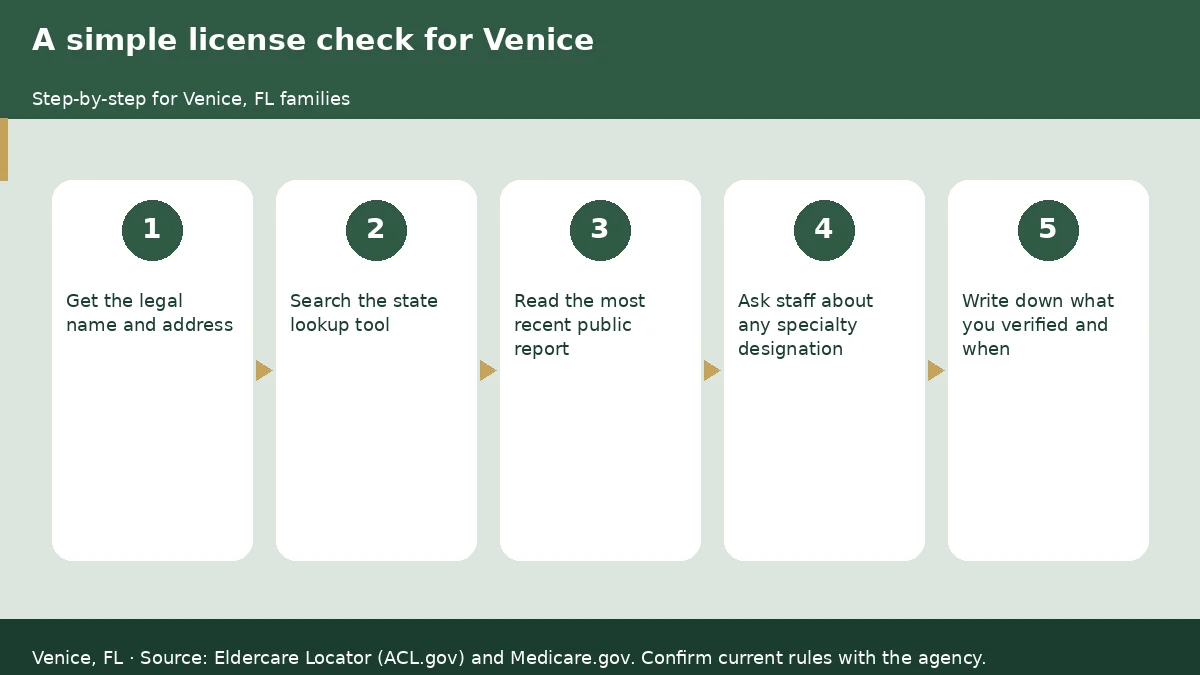
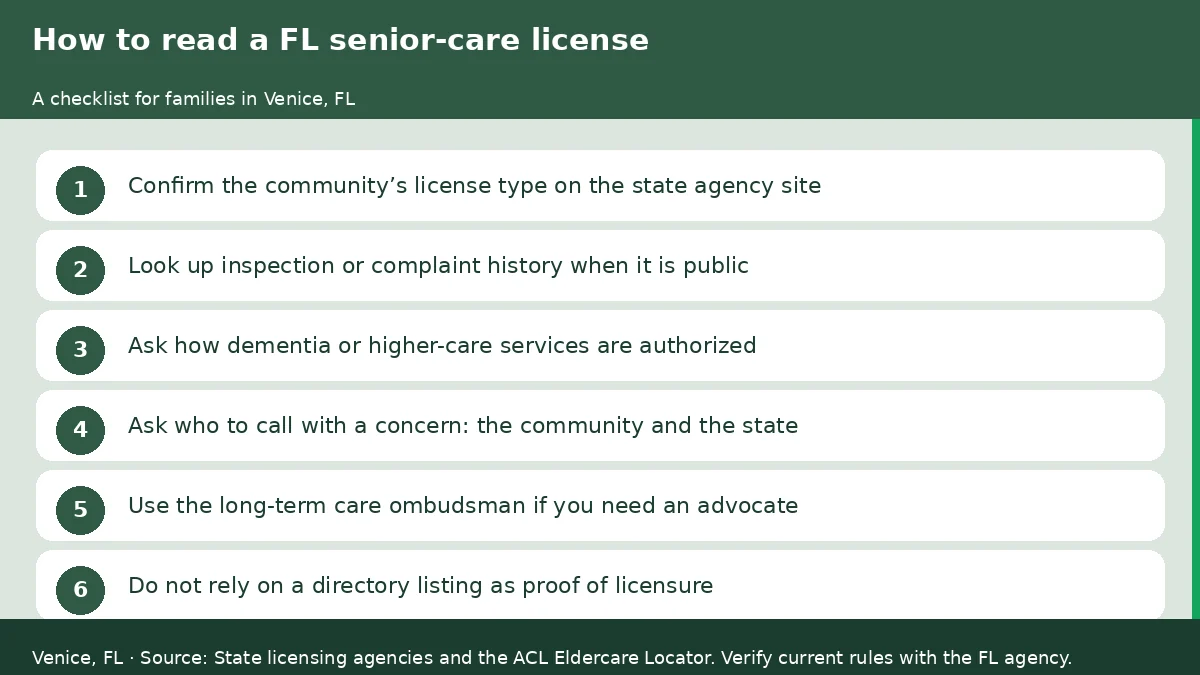
- Confirm the residence's legal name, address, license information and any ECC, LNS or LMH specialty license with AHCA.
- If memory care is advertised, ask about the required Alzheimer's and dementia training, supervision and the environment used to support residents.
- Ask AHCA what inspection information is available and how its complaint process applies; keep the agency's answer with your notes.
- Request a written description of services, current rates, additional charges and the terms for a respite stay. Regional medians are not the community's quote.
- Review Medicare, Medicaid, insurance and VA questions separately. A payment source's eligibility rules do not determine whether a residence is licensed or suitable.
- Consider the family's practical travel from South Venice, Nokomis, Englewood, North Port or Sarasota, including routes using US-41, the Tamiami Trail, and Interstate 75.
For a residence at 350 Magnolia Rd or anywhere else in Venice, the goal is a documented, unhurried comparison. Verify the license, ask precise training and oversight questions, understand the payment source and read the agreement. That approach respects both the person needing support and the spouse or adult child organizing the decision.
Frequently asked questions
Who licenses assisted living facilities in Venice, Florida?
Venice assisted living facilities are licensed at the state level by the Florida Agency for Health Care Administration, not by the city. The main framework is Part I of Chapter 429, Florida Statutes, with rules in Chapter 59A-36, Florida Administrative Code. Ask a residence for its exact license information and use AHCA's resources to clarify its license type, including any Extended Congregate Care, Limited Nursing Services or Limited Mental Health specialty license.
What should a Venice family ask about memory care training?
Florida requires Alzheimer's disease and dementia training for staff in facilities that advertise memory care. Ask who receives the training, how the community describes its memory care services, and what supervision and environmental support are available. The requirement is important, but it does not establish that a residence is the right fit. Memory care should be discussed as support, supervision and environment, never as a cure or a promised outcome for a Venice resident.
How can a Venice family ask about inspections or complaints?
Start by asking the residence for its license information and documenting your concern. Then contact the Florida Agency for Health Care Administration to ask what inspection information is available for that specific Venice address and how its complaint process applies. Keep dates, written responses and the names of the programs discussed. Do not infer an inspection schedule, a violation history or a likely complaint outcome from the fact that a residence is licensed.
Does Medicare pay for assisted living in Venice?
Medicare does not cover long-term custodial care when that is the only care needed, and most long-term care is custodial. That federal coverage rule applies in Venice just as it does elsewhere in Florida. Do not assume that needing help with bathing or dressing turns an assisted living monthly charge into a Medicare benefit. Florida Medicaid, long-term care insurance and VA pensions have separate eligibility rules that should be reviewed individually.
Are North Port Area cost figures the rates at Magnolia Gardens?
No. The community is at 350 Magnolia Rd in Venice and offers assisted living, memory care and respite stays. Call for current rates, and request a written explanation of included services, possible additional charges and how respite pricing is handled. Keep those answers separate from state licensing and training questions.
Talk with Magnolia Gardens Assisted Living
If you are weighing care options in Venice, call (941) 412-4092 or plan a visit. Our team can talk through current availability, rates and next steps. Please confirm all details directly, since published figures and listings change over time.
Sources
- VA Aid and Attendance and Housebound benefits
- VA pension rates (current)
- Medicare: long-term care coverage
- Eldercare Locator (U.S. Administration for Community Living)
- National Institute on Aging: What is respite care?
- the National Institute on Aging: respite care
- ACL: What is long-term care insurance
- Florida AHCA: Assisted Living Unit
- Florida AHCA: Statewide Medicaid Managed Care Long-Term Care Program
Program rules and benefit amounts were checked on the linked official pages in November 2026 and can change.
Related reading on this site: