How to Choose an Assisted Living Facility in Venice, FL
A practical framework for comparing care, location, licensing, costs, contracts and daily life before choosing an assisted living residence in Venice.
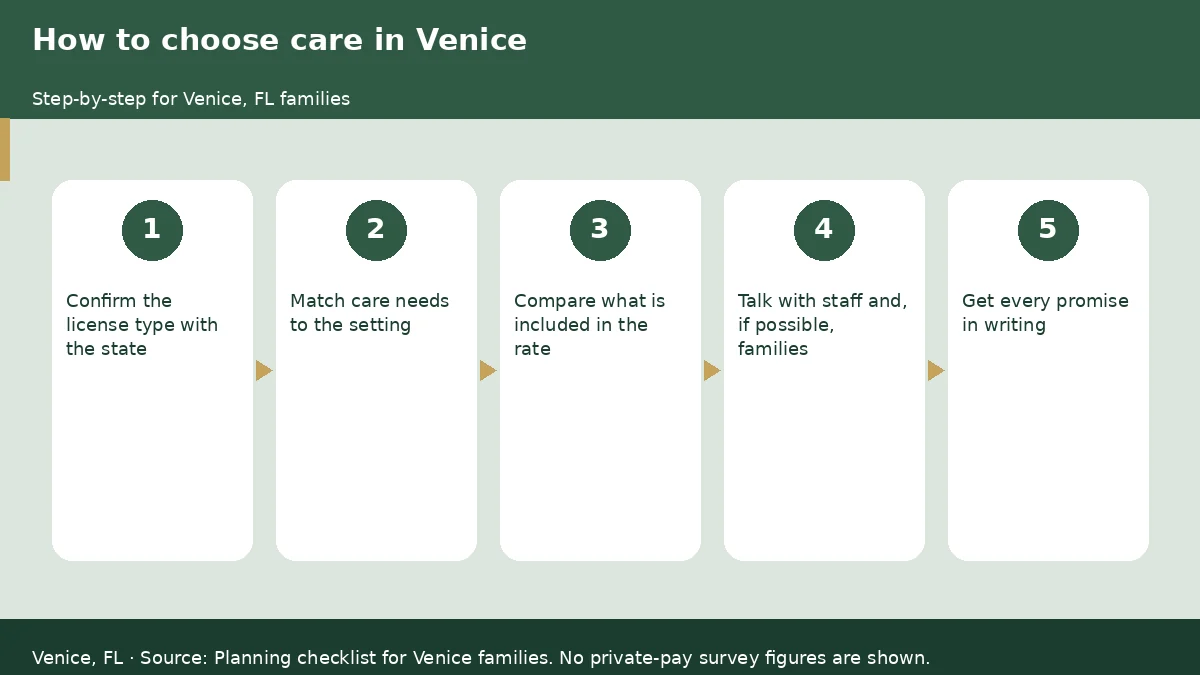
Choosing assisted living is rarely a single decision about a building. It is a series of decisions about daily help, safety, location, money and what happens if needs change. For families learning how to choose an assisted living facility in Venice FL, a written framework can keep a pleasant tour from overshadowing practical questions.
Start before visiting any residence. Write down what is difficult now, what is merely inconvenient and what would become unsafe without reliable help. Use the same notes and questions at every tour so that each setting is judged by consistent standards.
Start with a clear picture of daily needs
A needs list should describe actual routines rather than a broad label such as “independent” or “high care.” Include bathing, dressing, toileting, eating, mobility, medication routines, meal preparation and the ability to respond to an emergency. Note memory problems, nighttime waking, recent falls, loneliness and the tasks a spouse or adult child is currently handling.
Separate needs into three groups:
- Help needed every day, and the times it is usually needed.
- Help needed occasionally, such as transportation or standby assistance.
- Changes that may require a new assessment, including increased confusion or reduced mobility.
Bring relevant physician instructions and a medication list to the admission discussion. Ask who performs the assessment, how the service plan is written and when it is reviewed. This makes it easier to compare assisted living in Venice with support at home without assuming that every residence provides the same services.
Match the Venice location to real family routines
Convenience is not just mileage. A residence near US-41, also called Tamiami Trail, may suit one family, while access to Interstate 75 may matter more to relatives driving from North Port or Sarasota. Test the route from the homes of the people most likely to visit, and consider regular destinations such as physicians’ offices, pharmacies, faith communities and familiar shops.
Families in South Venice, Nokomis or Englewood should also consider bridge traffic, seasonal congestion and whether the drive remains manageable at the times visits would actually occur. During a tour, notice parking, the walk from the car, seating for visitors and whether there is a comfortable place to share a meal or conversation.
The Eldercare Locator can connect families with local aging-service resources. An independent conversation about available support can provide useful context before a deposit or contract narrows the options.
Verify the Florida license and inspection history
Florida’s Agency for Health Care Administration licenses assisted living facilities. Its Assisted Living Unit resources explain licensing and specialty categories, including Extended Congregate Care, Limited Nursing Services and Limited Mental Health. An adult family-care home is a separate license type. A residential appearance therefore does not establish what a setting is authorized to provide.
Ask the administrator for the exact licensed name and license number. If the online record is unclear, ask AHCA or the administrator where the current reports can be obtained. Do not rely on a marketing name, an attractive lobby or a verbal statement that everything is in order.
Also ask whether any specialty license applies to the services being discussed. Florida requires dementia-related staff training in facilities that advertise memory care. Request a plain explanation of who receives that training, how it is refreshed and which license or service arrangement applies if a resident’s needs increase.
Compare a small residential home with a larger community
Size changes the experience, but it does not by itself establish quality. A smaller setting may feel quieter and easier to learn, with fewer dining or activity spaces to navigate. A larger community may offer more scheduled programs, common areas or separate neighborhoods. These are possibilities to investigate, not guarantees.
In either setting, ask who is responsible overnight, how residents request help, how meals and activities are communicated and what happens when a regular staff member is absent. Observe whether staff appear rushed, whether residents can find staff easily and whether personal preferences receive specific answers.
On Florida’s Gulf Coast, emergency planning also deserves direct questions. Ask about evacuation and sheltering procedures, medication continuity, transportation and how families receive updates. The response should identify a process rather than simply reassuring visitors that emergencies are rare.
Use local cost figures without confusing them with quotes
For Venice, the uses its North Port Area. These are survey medians, not prices for any particular residence.
These categories are not interchangeable packages. In-home caregiver figures do not include housing, meals or utilities, while nursing homes serve needs that may differ substantially from assisted living.
None of these figures states a price for Magnolia Gardens. Families should call the home for current rates and request a written schedule showing included services, possible additional charges and the circumstances that can change a bill.
Require pricing transparency and a readable contract
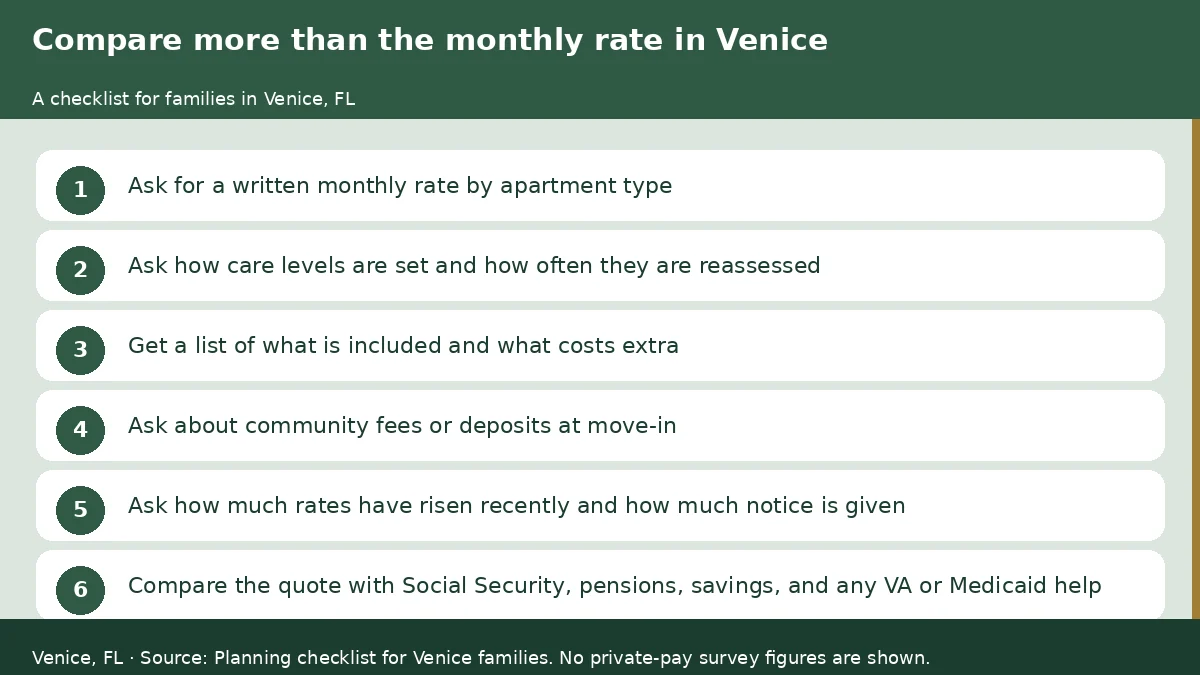
A useful quote identifies more than the base monthly charge. Before paying a deposit, request the admission agreement, service plan process, fee schedule and discharge policy. Take them home for review rather than relying on a tour summary.
- Ask which personal-care services, meals, laundry, transportation and activities are included.
- Ask how care levels are determined and who approves a change in charges.
- Check medication-related fees, supplies, deposits, entrance charges and rate-increase terms.
- Review notice requirements, refunds, hospital absences and responsibility for belongings.
- Ask what events can lead to discharge, who makes that decision and what assistance is offered with a move.
Be cautious with a broad promise that someone can remain indefinitely. Ask specifically about nighttime needs, mobility changes, dementia-related supervision, hospice involvement and circumstances requiring a higher level of care. Verbal assurances should match the written agreement.
Payment sources also need verification. Medicare’s long-term care guidance explains that Medicare does not cover custodial long-term care when that is the only care needed. Long-term care insurance may help depending on the policy, its benefit triggers, elimination period and covered settings. Veterans and surviving spouses can review VA Aid and Attendance eligibility. Florida’s Statewide Medicaid Managed Care Long-Term Care program can cover certain services for eligible people, but enrollment is limited and there is a waitlist; screening begins through the local Aging and Disability Resource Center.
Examine memory care and respite as specific services
Memory care should be evaluated as support, supervision and environment, not as a promise to stop or reverse dementia. Ask how memory care routines are structured, how entrances and exits are supervised, how staff respond to distress and how families are informed about changes. Request examples of daily activities and ask how personal history, food preferences and sleep patterns are incorporated into a service plan.
Respite serves a different purpose. The National Institute on Aging describes respite care as a short-term break for family caregivers, provided at home, in adult day centers or through short residential stays. For a short stay, ask about availability, the admission assessment, medication routines, included support and what records the family must supply. Clarify the departure plan and current rates before arrival.
How to choose an assisted living facility in Venice FL: finish with red flags and written comparisons
Red flags are especially important when they form a pattern. Slow down if a provider:
- Will not identify its license or provide documents before a deposit.
- Gives vague answers about assessments, overnight supervision or fee changes.
- Pressures a family to sign immediately or discourages outside review.
- Makes verbal promises that conflict with the contract.
- Cannot explain discharge, hospitalization or emergency procedures.
- Dismisses questions about inspections or corrective actions.
After each visit, score the same categories in writing: fit with current needs, likely adaptability, visiting practicality, licensing record, observed interactions, complete cost and contract clarity. Add unresolved questions and the name of the person responsible for answering them. This record is more reliable than comparing general impressions weeks later.
Magnolia Gardens Assisted Living is at 350 Magnolia Rd in Venice and offers assisted living, memory care and respite stays. Those facts identify services families can explore; the same detailed review still applies. A sound choice is one where written terms, observed routines, location and the person’s actual needs support one another.
Frequently asked questions
What should we assess before touring assisted living in Venice?
List the help needed with bathing, dressing, toileting, mobility, meals, medications and nighttime routines. Include memory concerns, recent falls and tasks family members currently perform. Separate daily needs from occasional needs, then bring physician instructions and a medication list to each discussion. This gives every Venice residence the same starting point and helps families distinguish included services from support that may require an additional assessment or charge.
How do we check a Venice assisted living facility’s Florida license?
Ask the administrator for the exact licensed name and license number, then match that information to the Venice address through the Florida Agency for Health Care Administration’s consumer resources. Also ask whether any specialty license applies. Do not assume that a residential appearance, marketing name or advertised service establishes the facility’s licensed scope.
Does Medicare pay for assisted living in Venice, Florida?
Medicare generally does not cover long-term custodial care when that is the only care needed, so families should not assume it will pay for assisted living room, board and personal assistance. Ask each Venice provider for a written explanation of charges instead. Veterans’ benefits, long-term care insurance and Florida Medicaid programs have separate eligibility rules and should be verified directly before making a financial plan.
What should families ask about memory care in Venice?
Ask how supervision is organized, how entrances and exits are managed, what dementia-related training staff receive and how families are notified of changes. Request examples of daily routines and activities, along with the process for updating a service plan. Memory care should be described in terms of support, supervision and environment. Be wary of language promising a particular change in the course of dementia.
Can a respite stay help a Venice family evaluate care options?
A respite stay can provide short-term relief for a caregiver and may help a family understand routines in a residential setting. Magnolia Gardens in Venice offers respite stays, along with assisted living and memory care. Ask about availability, the admission assessment, medications, included support, departure arrangements and current rates. A short stay should have its own written expectations rather than relying on assumptions from a tour.
Talk with Magnolia Gardens Assisted Living
If you are weighing care options in Venice, call (941) 412-4092 or plan a visit. Our team can talk through current availability, rates and next steps. Please confirm all details directly, since published figures and listings change over time.
Sources
- VA Aid and Attendance and Housebound benefits
- Medicare: long-term care coverage
- Eldercare Locator (U.S. Administration for Community Living)
- National Institute on Aging: What is respite care?
- ACL: What is long-term care insurance
- Florida AHCA: Assisted Living Unit
- Florida AHCA: Statewide Medicaid Managed Care Long-Term Care Program
Program rules and benefit amounts were checked on the linked official pages in November 2026 and can change.
Related reading on this site: