Ways to Pay for Assisted Living in Florida: A Guide for Venice Families
A practical Venice guide to costs, Medicaid, VA benefits, insurance and private funds, with clear steps for comparing care without confusing coverage with room and board.
Learning how to pay for assisted living in Florida becomes easier when a family separates three questions: what care costs locally, which benefits can pay for care services, and which expenses remain private. For Venice households, the useful benchmark is the North Port Area used for the North Port-Sarasota-Bradenton metro, not one community’s rate. Medicaid, VA pensions, insurance and Medicare have different purposes and cannot be treated as interchangeable monthly checks.
Magnolia Gardens Assisted Living is at 350 Magnolia Rd in Venice, in Sarasota County, and offers assisted living, memory care and respite stays. Adult children and spouses can use the steps below to compare care with support at home, protect a remaining spouse’s finances and check eligibility before a crisis. The goal is a written plan showing who pays, what is covered and what could change.
Start with the local cost picture
The , with data collected from July through November 2025, reports these medians and rates. A median is a planning benchmark, not a quote, and different care settings do not include identical housing, meals, supervision or services.
That comparison does not establish which setting fits a person, because scheduled hours and overnight support matter.
Shorter home-care schedules can look manageable until supervision needs spread across the day. Use these differences to test a budget, not to predict a particular resident’s bill.
How to pay for assisted living in Florida with private funds
Private pay can combine retirement income, Social Security, savings, proceeds from assets and help from relatives. Start by listing dependable monthly income separately from assets that must be sold or withdrawn. Then reserve money for a spouse remaining at home, ongoing household expenses and costs that a community does not include. A contribution from several relatives should be written down, including whether it is a gift, a loan or a temporary arrangement.
Home equity may enter the plan through a sale or another arrangement, but value on paper is not cash immediately available for care. A spouse may still need the home, and selling, renting or borrowing against it carries different legal, tax and practical consequences. Before transferring ownership or giving away assets, consult a Florida elder-law attorney and an appropriate tax professional. A transfer intended to simplify family finances can complicate a later VA or Medicaid claim.
Florida Medicaid: care services, room and board, and the waitlist
Florida’s relevant program is the Statewide Medicaid Managed Care Long-Term Care Program, often shortened to SMMC LTC. The Agency for Health Care Administration says it can cover assisted living services, personal care, adult day care and respite for Medicaid-eligible people who are 65 or older, or 18 or older with a disability, and who need nursing facility level of care. Financial and functional requirements apply. Enrollment is limited, and there is a waitlist.
- Begin screening through the local Aging and Disability Resource Center; the Elder Helpline is 1-800-963-5337.
- Do not assume that needing nursing facility level of care means having to live in a nursing home.
- Ask the managed care plan which services are authorized and whether a particular community participates.
- Keep a private-pay contingency while waiting for screening, enrollment and service authorization.
Coverage of assisted living services is not a promise to pay the entire community bill. Room and board must be separated from covered care services. Ask the plan and the community to identify in writing which charges the program pays, which remain the resident’s responsibility and when payment responsibilities begin. Magnolia Gardens’ participation or rates should not be assumed from the existence of the state program.
VA Aid and Attendance: pension support with specific limits
VA Aid and Attendance is an increased monthly amount added to a VA pension, not a stand-alone assisted living voucher. It may apply to eligible wartime-era Veterans or surviving spouses who need help with daily activities such as bathing, dressing or eating, are bedridden, live in a nursing home because of lost abilities, or have limited eyesight. VA determines eligibility and the amount payable.
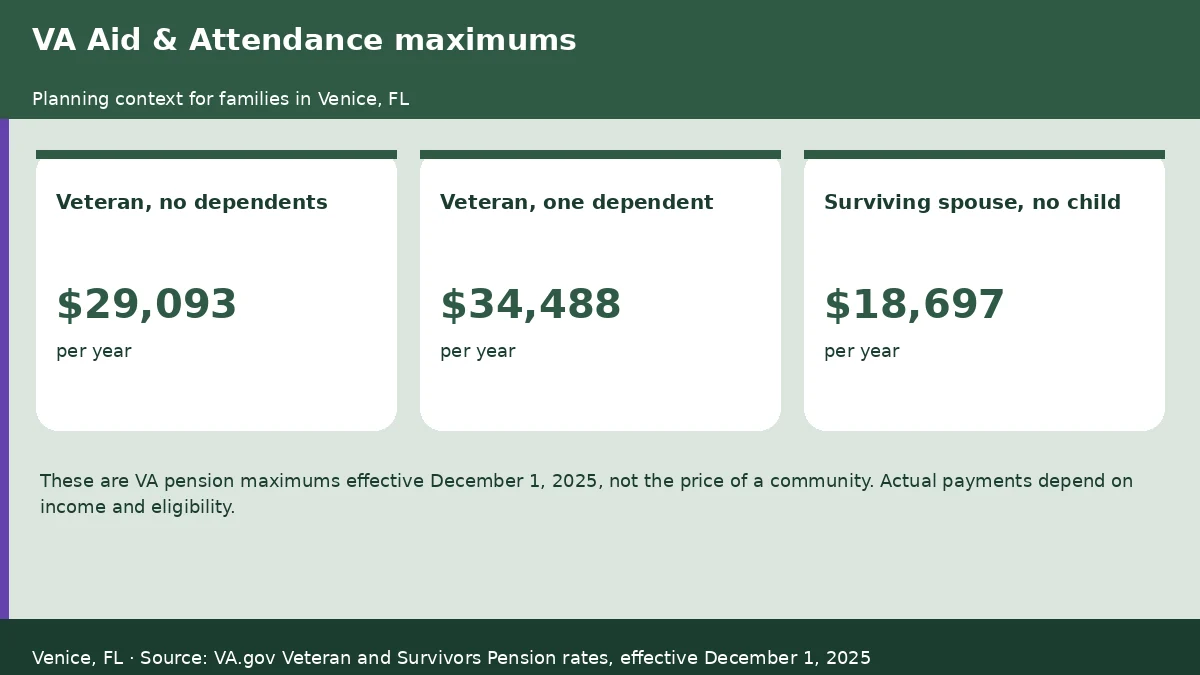
The current VA pension rates, effective December 1, 2025, list these Maximum Annual Pension Rates with Aid and Attendance:
These are not automatic assisted living payments. Pension equals the applicable annual rate minus countable income. VA says unreimbursed medical expenses, which can include care costs, above 5% of the maximum rate can reduce countable income, so retain invoices and payment records. The net worth limit from December 1, 2025 through November 30, 2026 is $163,699.
VA also reviews asset transfers during the 3 years before a claim, with a penalty period of up to 5 years. Do not give away property simply to try to qualify. Obtain advice that considers the Veteran, a surviving spouse and the household’s complete finances.
Long-term care insurance and Medicare play different roles
Read the insurance policy before counting its benefits
Long-term care insurance can pay for services such as assisted living, depending on the policy. Benefits usually start after an elimination period and when the policyholder needs help with activities of daily living or has cognitive impairment. Ask the insurer whether the setting qualifies, what licensure evidence it requires, how the elimination period is counted and what documentation must accompany a claim. Also confirm whether supervision in a memory care environment changes any requirement. A policy summary or another family’s claim experience cannot substitute for the actual contract.
Do not assign ongoing custodial costs to Medicare
Medicare’s long-term care coverage guidance says Medicare does not cover long-term care, also called custodial care, if that is the only care needed. Most long-term care is custodial. Families should therefore not pencil in Medicare for continuing assisted living room and board, daily personal support or memory care supervision. Keep Medicare health coverage questions separate from the search for a long-term care payment source.
Match the payment plan to the care setting
A funding plan should follow care needs rather than forcing needs to fit a benefit. When comparing assisted living in Venice with memory care, describe memory care in terms of support, supervision and environment, not promised changes in dementia. Write down the help needed with daily activities, the supervision required during the day and overnight, and the gaps family caregivers can realistically fill.
Respite can also belong in the discussion. The National Institute on Aging explains respite care as a short-term break for family caregivers, provided at home, through adult day centers or during short residential stays. Magnolia Gardens offers respite stays alongside assisted living and memory care. A family can ask how a respite stay would be billed without treating it as a promise about a future placement.
For current Magnolia Gardens rates, call (941) 412-4092 and request a written explanation of what is included, how care-related charges are identified and how room-and-board charges are described.
Where Venice families can find help and organize next steps
The Eldercare Locator, a service of the U.S. Administration for Community Living, connects families with local aging resources at 1-800-677-1116. Ask for the Area Agency on Aging serving Venice and Sarasota County, and use the Elder Helpline route above for Florida long-term care screening. For dementia caregiving and respite guidance, the the National Institute on Aging operates its 24/7 Helpline at 1-800-272-3900.
- Create one secure folder for the insurance policy, VA documents, income and asset records, care invoices and written community quotes.
- Use the same categories for every option: recurring room and board, care services, one-time charges and expenses still owed at home.
- Record application dates, waitlist contacts, insurance elimination periods and authorized benefits. Revisit the plan when care needs or caregiver availability change.
For Venice families, how to pay for assisted living in Florida is best answered on paper. A clear comparison of services, room and board, benefit decisions and private reserves gives spouses and adult children a steadier basis for decisions than any single monthly benchmark.
Frequently asked questions
Does Florida Medicaid pay room and board at an assisted living facility in Venice?
Florida’s Statewide Medicaid Managed Care Long-Term Care Program can cover assisted living services for people who meet financial, functional and program requirements, but that is not the same as paying an entire private facility bill. Room and board should be identified separately. Screening begins through the local Aging and Disability Resource Center, enrollment is limited, and a waitlist applies. Ask the managed care plan and the Venice community for written payment responsibilities.
Can VA Aid and Attendance help pay for assisted living in Venice?
Aid and Attendance can increase an eligible Veteran’s or surviving spouse’s VA pension, and that pension income may help with assisted living expenses. It is not an automatic payment to a Venice community and does not guarantee full coverage. VA reviews pension eligibility, countable income, net worth and qualifying care needs. Wartime-era service rules also matter. Keep care invoices and other unreimbursed expense records, and avoid transferring assets without advice because VA reviews certain transfers before a claim.
Will Medicare cover memory care or assisted living in Venice?
Medicare does not cover long-term custodial care when that is the only care needed, and most long-term care is custodial. That means families should not count on Medicare for ongoing assisted living room and board, daily personal support or memory care supervision in Venice. Memory care should be understood as support, supervision and environment, not a treatment promise. Review private funds, Medicaid eligibility, VA benefits and any long-term care insurance instead.
How do Venice-area assisted living costs compare with state and national benchmarks?
The metro benchmark is used for Venice, but it is not a rate quote for Magnolia Gardens or any other community. Ask for current rates, included services, care-related charges and room-and-board terms. Also compare home care by scheduled hours rather than assuming an hourly rate equals full-time supervision.
Where can a Venice family get free help with long-term care planning?
Start with the Eldercare Locator at 1-800-677-1116 and ask for the Area Agency on Aging serving Venice and Sarasota County. For Florida’s long-term care Medicaid screening, contact the local Aging and Disability Resource Center through the Elder Helpline at 1-800-963-5337. The the National Institute on Aging Helpline at 1-800-272-3900 is another source of dementia caregiving and respite guidance. These services can explain routes to help, but communities and agencies must confirm individual eligibility and payment.
Talk with Magnolia Gardens Assisted Living
If you are weighing care options in Venice, call (941) 412-4092 or plan a visit. Our team can talk through current availability, rates and next steps. Please confirm all details directly, since published figures and listings change over time.
Sources
- VA Aid and Attendance and Housebound benefits
- VA pension rates (current)
- Medicare: long-term care coverage
- Eldercare Locator (U.S. Administration for Community Living)
- National Institute on Aging: What is respite care?
- the National Institute on Aging: respite care
- ACL: What is long-term care insurance
- Florida AHCA: Statewide Medicaid Managed Care Long-Term Care Program
Program rules and benefit amounts were checked on the linked official pages in November 2026 and can change.
Related reading on this site: