Assisted Living Tour Checklist for Venice Communities
A practical, printable-style guide to touring assisted living in Venice, with questions about care, safety, dining, rooms, contracts and local costs.
An assisted living tour checklist for Venice, FL, gives a family something more reliable than a first impression. A pleasant lobby matters, but daily help, communication, safety practices and contract terms will shape life after move-in. Bring the same core questions to every visit and leave space for notes. Magnolia Gardens Assisted Living is at 350 Magnolia Rd in Venice, in Sarasota County, and offers assisted living, memory care and respite stays. The questions below can guide a visit there or help you compare other local options without assuming that any community provides a particular service.
Assisted living tour checklist for Venice, FL: before you visit
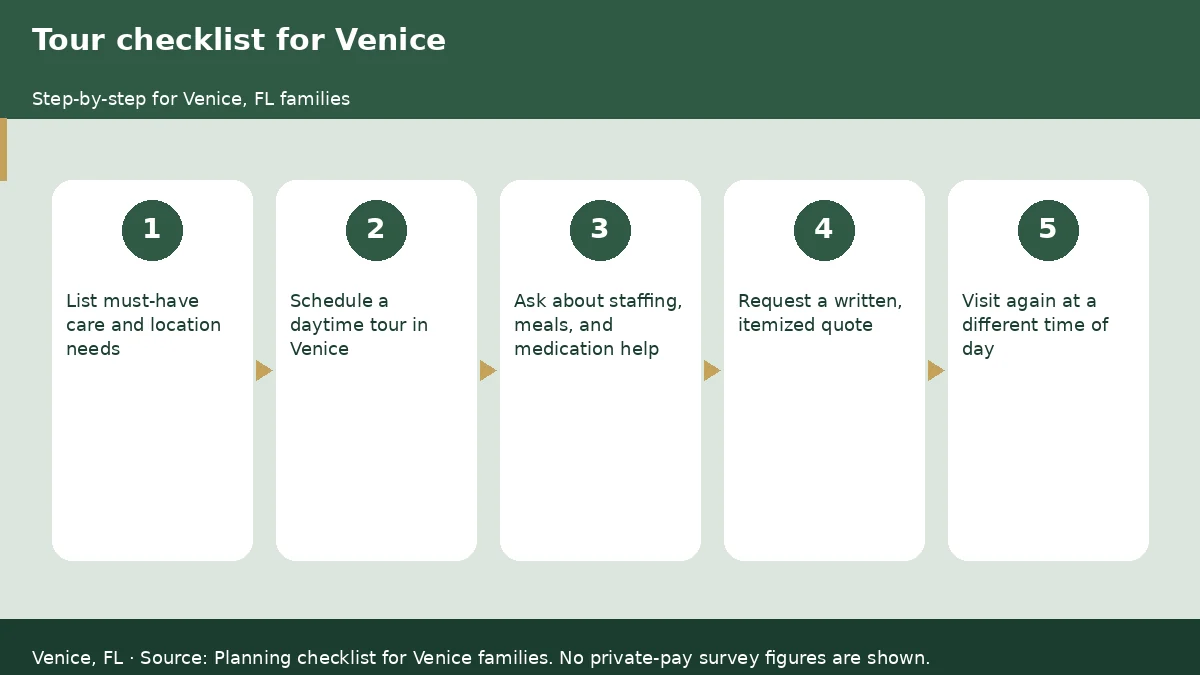
Start with your family member's actual routines rather than a generic list of amenities. Note where help is needed, which tasks remain independent and what tends to cause stress for the family caregiver. A tour becomes more useful when staff can respond to specific situations instead of describing care only in broad terms.
Venice's seasonal traffic, summer heat and stormy weather can affect the day. Allow extra travel time, especially if using US-41 or Interstate 75, and notice whether the route would be manageable for relatives coming from South Venice, Nokomis, North Port or Sarasota.
- Write down current needs: bathing, dressing, mobility, meals, medication routines, memory concerns and overnight supervision.
- Bring relevant documents: a medication list, physician instructions and notes about recent changes that staff may need to understand.
- Clarify the purpose: ask whether the visit includes a care discussion, a meal, an activity or a look at the type of room being considered.
- Include the right people: decide who will ask about care, who will review finances and how your loved one wants to participate.
- Prepare follow-up questions: ask what assessment is needed before staff can discuss an appropriate care setting.
First impressions: arrival, atmosphere and layout
Observe without treating cleanliness or decor as proof of good care. A community can look quiet because residents are engaged elsewhere, or it can feel busy during a routine transition. Note what you see, then ask staff to explain anything unclear.
- Are entrances, walkways and common areas clean, well lit and easy to move through?
- Do residents appear comfortably dressed and able to speak with staff when they choose?
- Are interactions patient and respectful, including when someone needs repeated directions?
- Is the noise level comfortable, and are there quieter places for conversation or rest?
- Can a person using a walker or wheelchair reach dining and activity areas without awkward obstacles?
- Are outdoor areas visible and maintained, and does staff explain how residents use them?
- Do odors, unanswered call signals or visible clutter reflect a brief situation or a pattern you should ask about?
Staff and care: assisted living and memory support
Ask who assesses needs, who writes the care plan and how often it is revisited. Also ask which employees are present during evenings and overnight, how a concern reaches a supervisor and when families are contacted. The pages on assisted living in Venice and memory care can help frame separate questions about personal assistance and memory support.
Memory care should be discussed in terms of support, supervision and environment. Ask how staff respond to confusion, how exits and outdoor spaces are managed, and how routines are adapted. Florida's Agency for Health Care Administration licenses assisted living facilities and requires dementia-related training for staff in facilities that advertise memory care; its assisted living licensing overview also explains specialty license types.
- How are bathing, dressing, mobility and medication assistance scheduled and documented?
- What happens when needs increase, and which changes could require another care setting?
- How are falls, wandering, refusal of care or sudden confusion discussed with families?
- How are new employees trained, and how is dementia education kept current?
- How does the community coordinate with outside physicians, therapists or home health providers?
- Who is the family's regular contact, and what is the expected process for nonemergency questions?
Safety and rooms: test the everyday details
Safety questions should cover ordinary routines as well as emergencies. Ask to see the general room type under consideration, while respecting current residents' privacy. A model room can show finishes, but it may not reveal storage limits, bathroom access or the view from an actual available unit.
- Bathroom access: look at doorway width, flooring, lighting, grab bars and space for another person to assist.
- Calling for help: ask how a resident requests assistance from the room and bathroom, and how staff receive the alert.
- Personal belongings: ask what furniture may be brought, how valuables are handled and whether familiar items can be arranged safely.
- Comfort: ask about temperature controls, window coverings, laundry, maintenance requests and measures used to reduce outside noise.
- Memory support: ask how staff balance supervision with privacy and how they respond if someone tries to leave unsafely.
- Storm readiness: request an explanation of evacuation or sheltering plans, family communication and backup power. Ask which systems backup power supports rather than assuming.
- Transfers and records: ask what happens during a hospital stay and how instructions are reviewed when the resident returns.
Dining and activities: look beyond the printed calendar
A sample menu and activity calendar are starting points, not evidence of the daily experience. If possible, observe part of a meal or program. Notice whether staff allow enough time and whether residents who need prompting receive it without being rushed or singled out.
- How are meal choices handled when a resident dislikes the main option?
- How does the community follow clinician-ordered texture changes or dietary restrictions?
- Are snacks and drinks available between meals, and how is assistance offered?
- Where do residents eat when they prefer a quieter setting or arrive late?
- How are activities adapted for different mobility, hearing, vision and memory needs?
- Are there opportunities for conversation, time outdoors and familiar household routines, as well as scheduled group programs?
- How are residents invited to participate without being pressured?
- Which transportation options exist, and what arrangements or charges apply?
Costs and contracts: compare the full monthly picture
Cost context can help families prepare questions, but a survey median is never a community quote. That local region is used here for the North Port-Sarasota-Bradenton metro comparison; it is not a Venice-only median.
Housing, meals, activities, hours of assistance and the level of care can differ substantially.
- Request a written rate sheet showing the base charge, care-related charges and other recurring fees.
- Ask what could trigger a care-level reassessment or a change in monthly charges.
- Review deposits, community fees, notice periods, refunds and charges after a temporary absence.
- Ask about rate increases, contract termination and what happens if care needs exceed the license or available services.
- For respite, ask how the stay is billed and which furnishings, meals and assistance are included.
Call Magnolia Gardens at (941) 412-4092 for current rates and to ask which charges would apply to your family member's situation.
Payment questions to resolve after the tour
Do not assume that a familiar insurance or benefit program will pay the monthly bill. Medicare's long-term care guidance says Medicare does not cover long-term custodial care when that is the only care needed, and most long-term care is custodial.
- Long-term care insurance: benefits depend on the policy. The Administration for Community Living's insurance explanation describes elimination periods and benefit triggers involving daily activities or cognitive impairment. Ask the insurer what documentation and preauthorization are required.
- Medicaid: Florida's Statewide Medicaid Managed Care Long-Term Care program can cover assisted living services and other supports for eligible people who need a nursing facility level of care. Enrollment is limited and there is a waitlist. Screening begins through the local Aging and Disability Resource Center, and program coverage does not mean every community participates.
- VA benefits: Aid and Attendance can increase a VA pension for eligible wartime-era Veterans or surviving spouses who meet care or other qualifying conditions. The VA's eligibility overview explains those conditions.
The VA's current pension rates list a maximum annual pension rate with Aid and Attendance of $29,093 for a Veteran with no dependents, or a maximum monthly pension of $2,424 if countable income were zero. These are not flat payments. The listed net worth limit for December 1, 2025 through November 30, 2026 is $163,699, and income, assets and prior transfers also require review.
After the visit: compare notes and verify answers
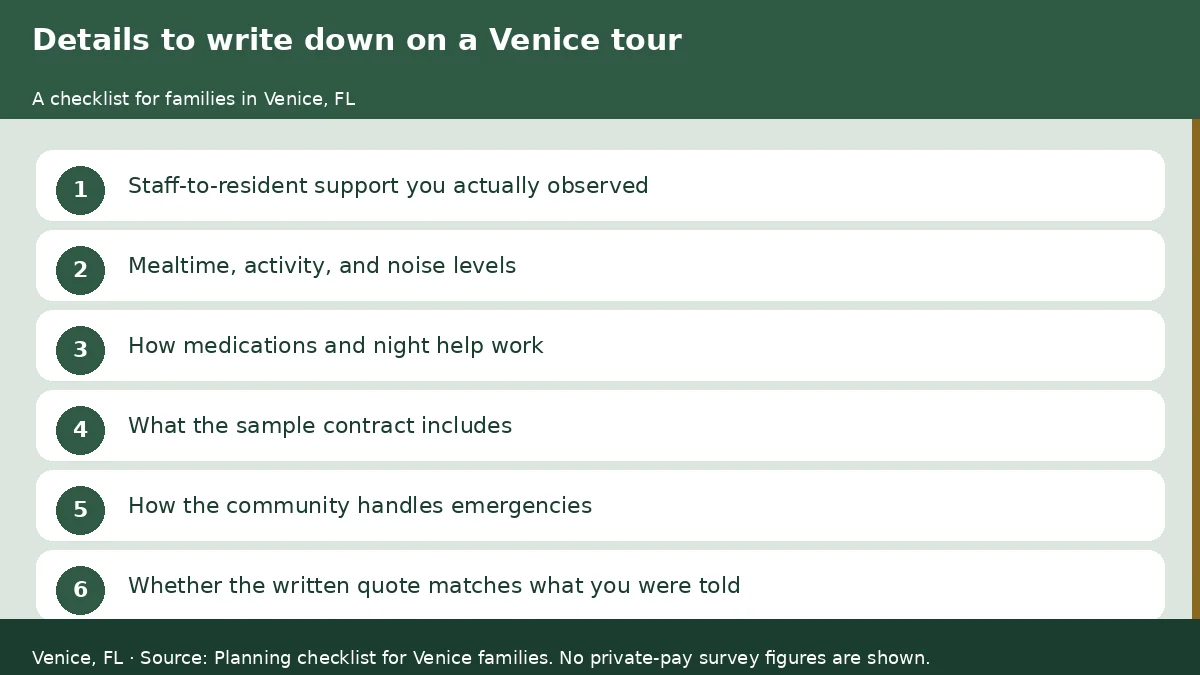
Complete your assisted living tour checklist for Venice, FL, while details are still fresh. Separate direct observations from staff statements, and mark every question that needs a written answer. Compare communities on the same care needs rather than choosing whichever tour felt most polished.
- List the daily tasks your loved one needs help with and note how each community explained them.
- Reconcile the base rate, likely care charges and possible extra fees without estimating a final price.
- Ask for clarification on any vague answer about staffing, transfers, emergency plans or contract changes.
- Consider a return visit at a different time, including your loved one when that would be comfortable and useful.
- Repeat the drive from the relatives who will visit most often, considering season, weather and time of day.
A short residential stay may also be worth discussing. The National Institute on Aging's respite care overview explains that respite can give family caregivers a short-term break and may take place in a residential setting. Magnolia Gardens offers respite stays; ask about current availability, assessment requirements and what the stay includes. A careful second look, clear written answers and a realistic understanding of care needs provide a stronger basis for comparison than any single tour.
Frequently asked questions
What should I bring to an assisted living tour in Venice?
In Venice, allow extra travel time during busy seasonal periods and consider heat or storm weather. Ask whether your loved one can join part of the visit, and request permission before taking photographs. Use the same checklist at each community so later comparisons rely on notes rather than the strongest first impression.
How should I compare assisted living and memory care on a Venice tour?
Ask how each option provides daily help, supervision and a suitable environment. Assisted living questions should cover personal care, medication support and changing needs. Memory care questions should cover dementia training, exit management, daily routines and communication during confusion or distress. Magnolia Gardens offers both assisted living and memory care, but a tour alone cannot determine fit. Ask how staff assess needs, involve the family and revisit the care plan when circumstances change.
What does assisted living cost near Venice, Florida?
These are market reference points, not Magnolia Gardens' rates. Call the community for current pricing, and request a written explanation of base charges, care-related fees and other possible costs.
Does Medicare pay for assisted living in Venice?
Medicare does not cover long-term custodial care when that is the only care needed, and most long-term care is custodial. Families should therefore not assume that Medicare will pay an ongoing assisted living bill in Venice. Ask each community for a written breakdown of charges, then review any long-term care insurance, VA eligibility or Florida Medicaid pathways separately. A separately covered skilled service should not be confused with coverage for residential custodial care.
Can a respite stay help a Venice family evaluate assisted living?
Respite care gives family caregivers a short-term break and can include a temporary stay in a residential community. Magnolia Gardens offers respite stays, so families can ask about availability, assessment requirements, length of stay and included services. A stay may provide a closer look at meals, routines and communication than a brief tour, but it does not guarantee a particular care outcome. Confirm all charges and care arrangements in writing beforehand.
Talk with Magnolia Gardens Assisted Living
If you are weighing care options in Venice, call (941) 412-4092 or plan a visit. Our team can talk through current availability, rates and next steps. Please confirm all details directly, since published figures and listings change over time.
Sources
- VA Aid and Attendance and Housebound benefits
- VA pension rates (current)
- Medicare: long-term care coverage
- National Institute on Aging: What is respite care?
- ACL: What is long-term care insurance
- Florida AHCA: Assisted Living Unit
- Florida AHCA: Statewide Medicaid Managed Care Long-Term Care Program
Program rules and benefit amounts were checked on the linked official pages in November 2026 and can change.
Related reading on this site: